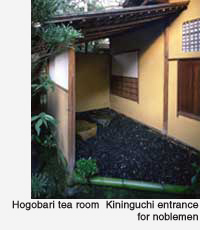
The Sodo (Founder's Hall) has a passageway between a four-and-a-half mat room and a hogobari tea room (the lower part of the walls are coverd with old letters and documents). Going through the low kininguchi (nobles' entrance) that has two shoji (sliding paper screen doors), the interior is a two mat room. The host's mat is a daime (small-sized) tatami with a board on the other side of the hearth. There is no toko (alcove) and scrolls are hung on the wall behind the host's mat. This is called a kabedoko (wall used as an alcove). The ceiling is entirely taketaruki ('hanging bamboo'), a slanting kesho yaneura roof of bamboo laths. Old letters and documents are used for the paper on the walls and on the taikobari doors (with paper covering the whole door, including the frames). This is the height of wabi, in that the design of the room could not be simpler. Previously, Sotan built a one-and-a-half mat room without a toko and with a board on the other side of the hearth. The one-and-a-half mat room that was built in Koshin's time was perhaps brought back to life here.
In the inner part of the Sodo there is a spacious preparation room with some of the latest devices, such as a convenient nagaro ('long hearth') with chains that can be moved left or right and up or down to adjust the position of pots or kettles, and a folding cabinet for food trays.
|